
Athina Botonaki
she/her
Artist/Architect
athinabotonaki@gmail.com και 00306972595681
athinabotonaki.com / @athinabot
Σκηνογραφία-Theatre Design/Scenography, διάρκεια: ένα έτος, αποφοίτηση: 2021
Athina was born in Chania, Greece, in 1994. She studied architecture in Aristotle University of Thessaloniki (GR), where she obtained her diploma in 2018. She worked a few years as an architect and gained experience in design, construction and supervision, both in collaboration with architectural offices as well as on her own work. Seeking a link between her acquired knowledge and her love for performing arts, she attended Theatre Design and Theatre Lighting Design seminars. In 2022 she started studying at the Master Interior Architecture program in the Royal Academy of Art in The Hague (NL), where, expanding the field of her practice beyond the strict architectural framework, she explored the fields of fictional storytelling, scenography, and immersive installation. After her graduation, her set design installation FAR FROM IT was selected to be exhibited at the Dutch Design Week 2024, and she was offered the position of alumni teaching assistant, at the MA Interior Architecture department.
Writings, poems and random script ideas always swirl inside her head, thus her notebooks’ margins are full of tiny texts that she often retraces for inspiration and reflection. Keeping storytelling in the centre of her practice, Athina focuses on spatial experience and narrative design, aiming at subtle yet engaging ways to address urgent matters.
guidance: Maria Chaniotaki
October 2020 – June 2021
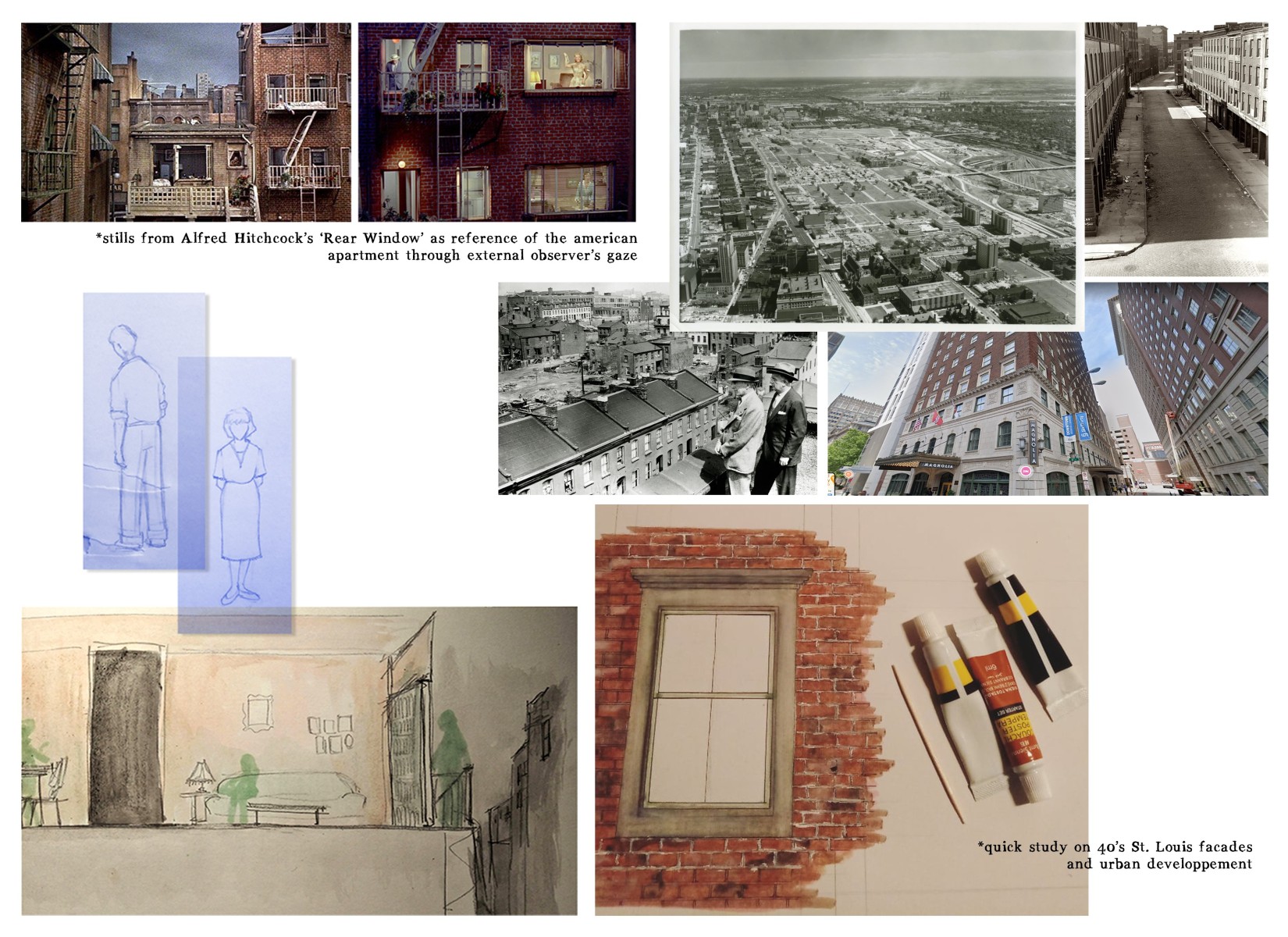
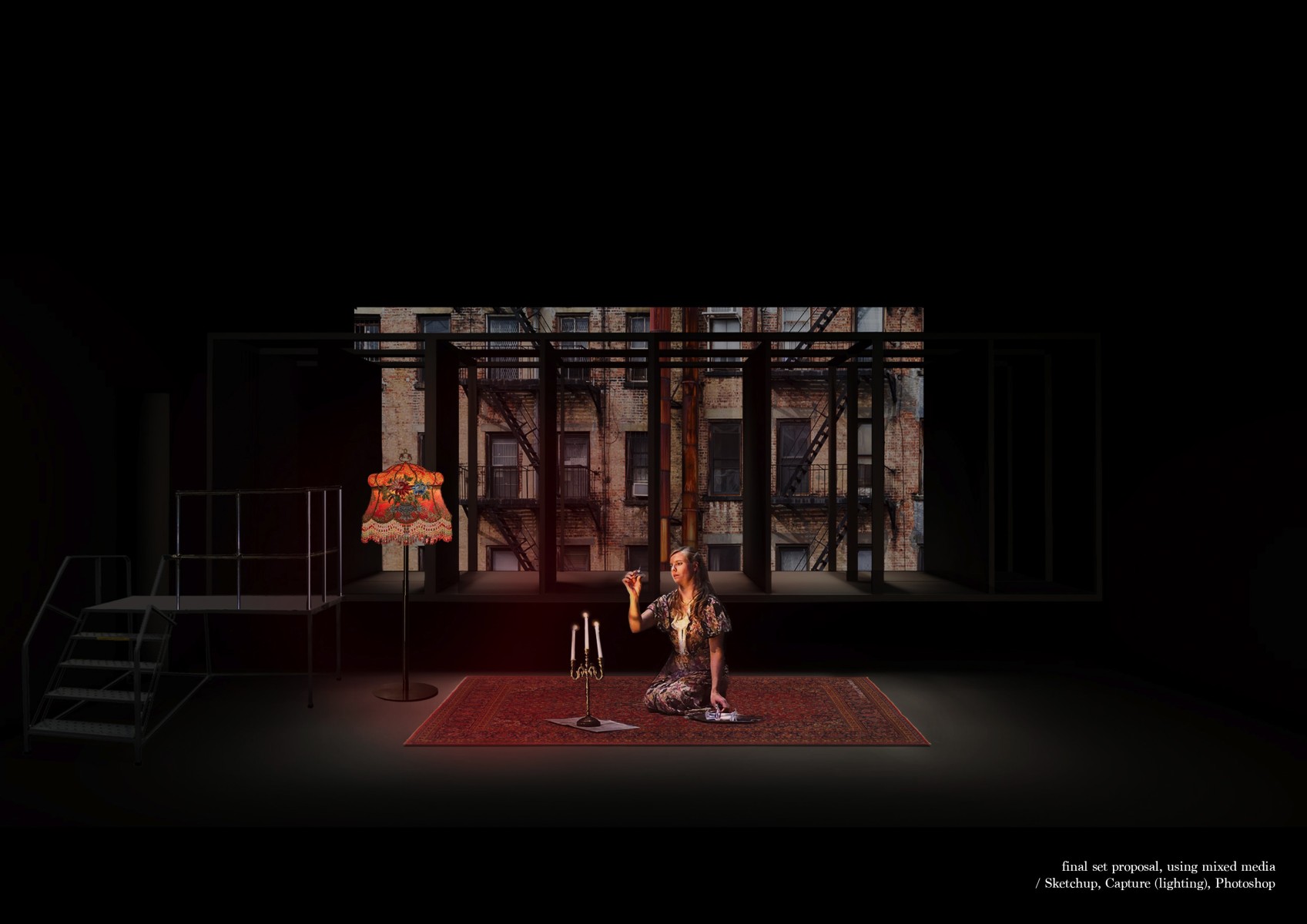
In this famous Tennessee Williams’ play, the setting of Wingfield’s house is based on Tom’s recollections, and follows the fragmentary and – often abstract – nature of memory. It doesn’t matter how precisely the rooms are arranged, nor the exact number of furniture and objects in the living room; the approach to space is mainly intuitive.
The large carpet at the centre of the stage; a symbol of homely warmth and bygone childhood. Tom remembers all of its details, as he played lying on the floor for hours, drawing whole worlds in-between its threads. The rose lampshade of the floor lamp, whose reddish light defined the night atmosphere of the house. And, of course, the portrait of the father, which dominates in a prominent position, only as a reminder of his absence.
Another key element of the composition is the external metal staircase, the one that connects the inside to the outside; the tight family circle with the public space; the unbearably repetitive everyday life with the bright, lively world of the movie theatres and nightclubs, who’s neon lights tremble softly at the end of the narrow street. We often meet Tom on the metal handrail smoking, day-dreaming, walking the line between the two worlds.
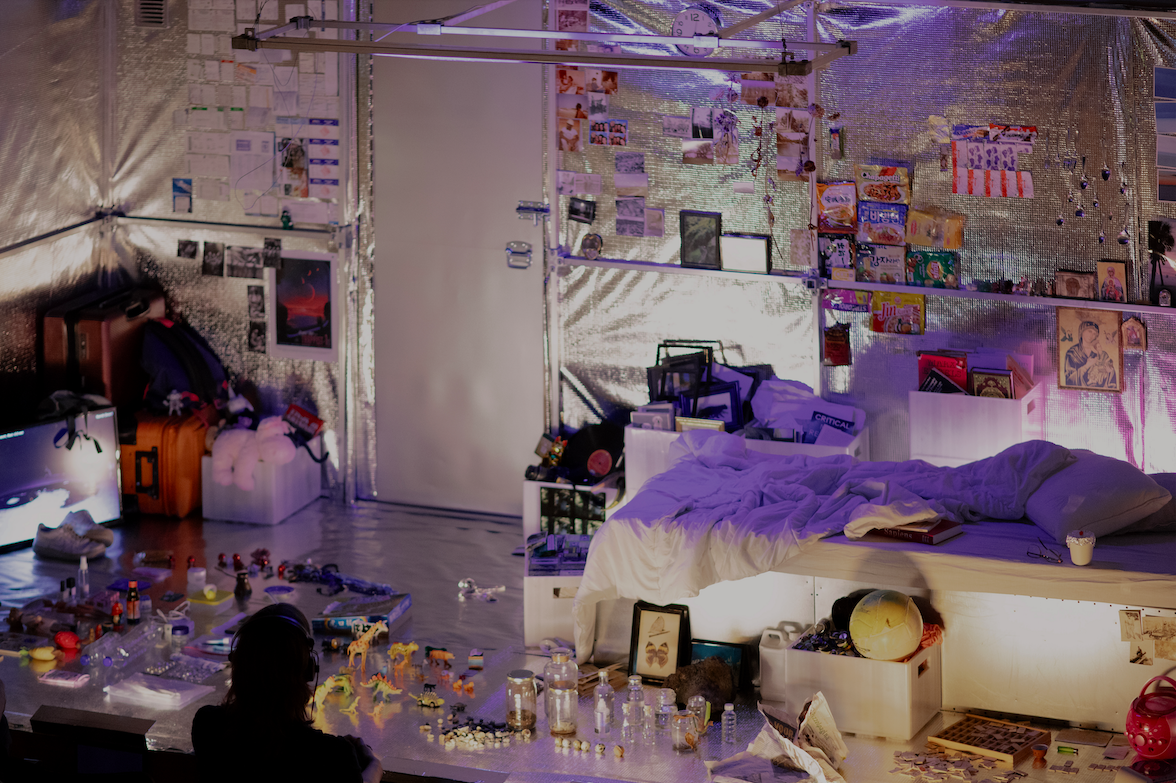


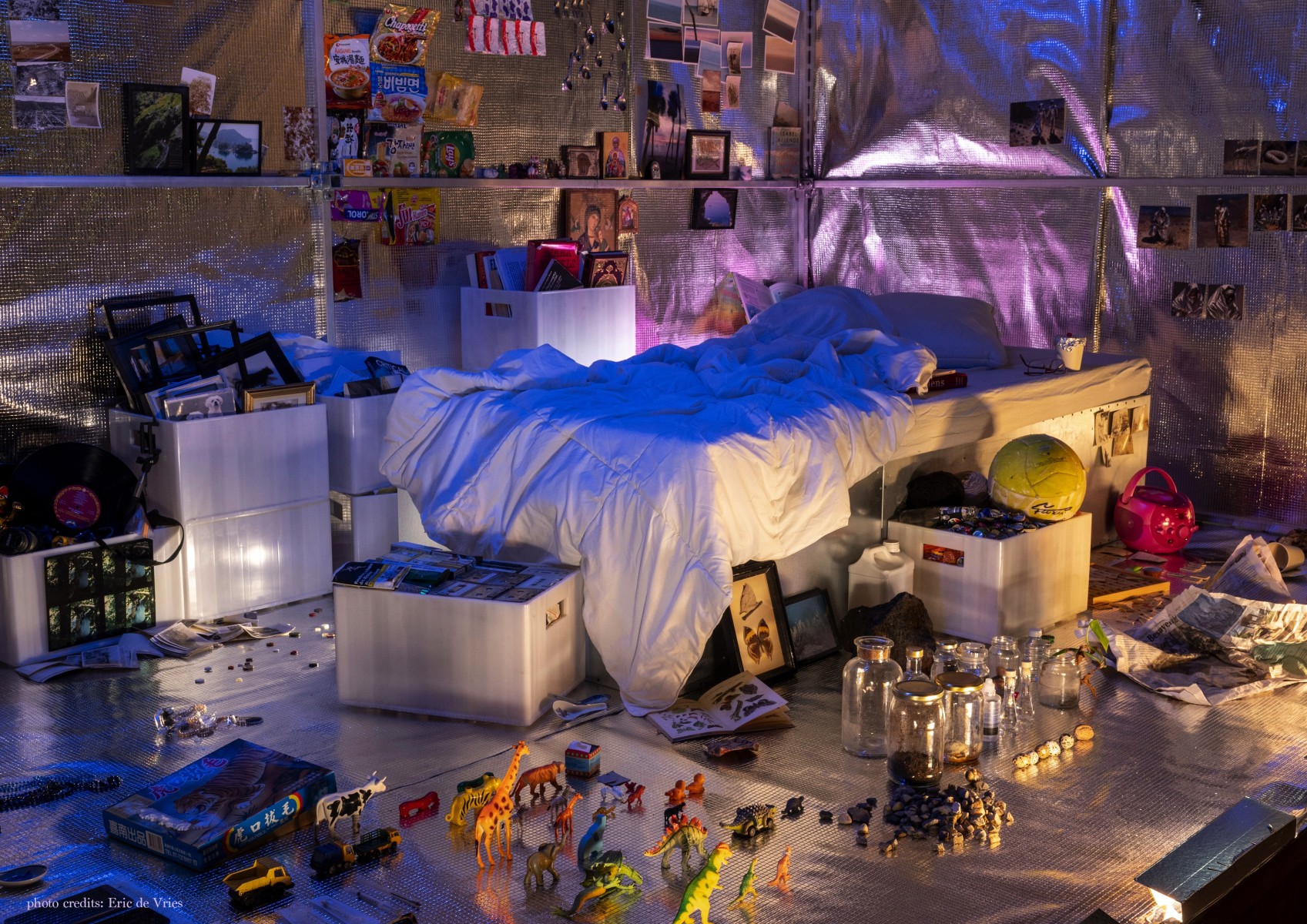
FAR FROM IT
“A young woman recalls some of her last encounters with her father. Through a fragmentary landscape of memory, she unravels a chronicle of nostalgia, as perceived by two different generations.”
Personal memory, loss, and grief, disguised in the form of our belongings, shape our intimate spaces. Hoarding, as a compulsive behaviour, seems to provide a sense of safety and control through the accumulation of possessions, as it satisfies the need to keep one’s environment intact. Yet the things we choose to surround ourselves with are usually nostalgic traces, not only of past experiences, but also of general time periods that we, ourselves, may never have known. Can we then see compulsive accumulation as something creative? Or, in other words, is hoarding a world-building practice?
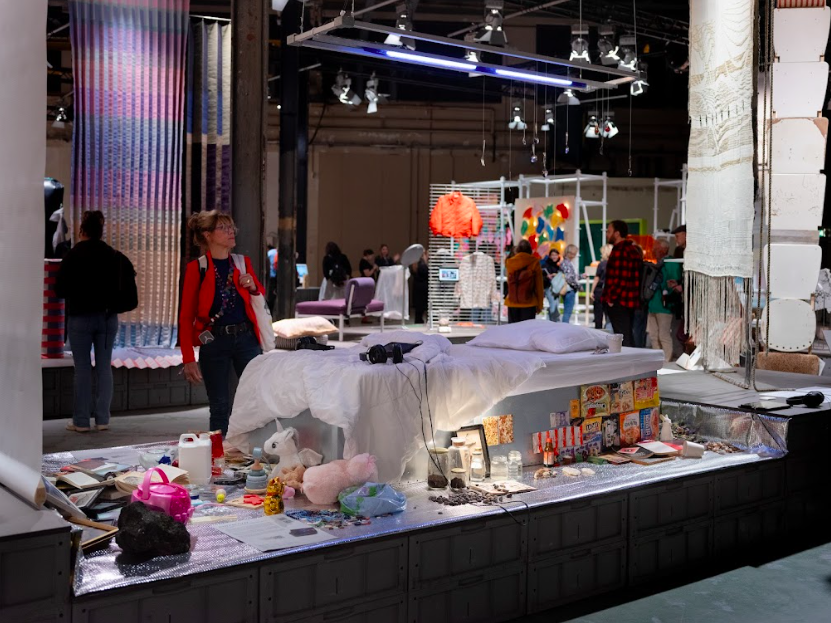
FAR FROM IT is the title of my graduation project at the Master Interior Architecture [INSIDE] program, in the Royal Academy of Art, The Hague. It is a time-based spatial installation that hovers between a theatre play and an audio book; placed on a small stage, it is a set frozen in time, filled with traces of a performance that has already happened. Based on a sci-fi story, the project invites us to have a look at nostalgia and migration through the lens of the current climate crisis and the inevitable end of the world as we know it.
[duration 15min.]